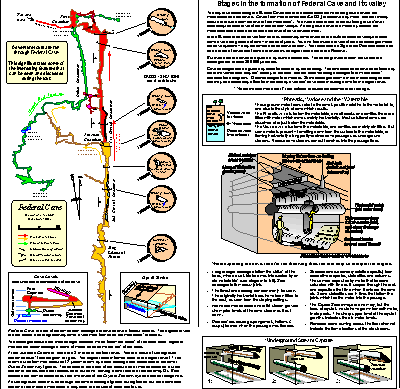
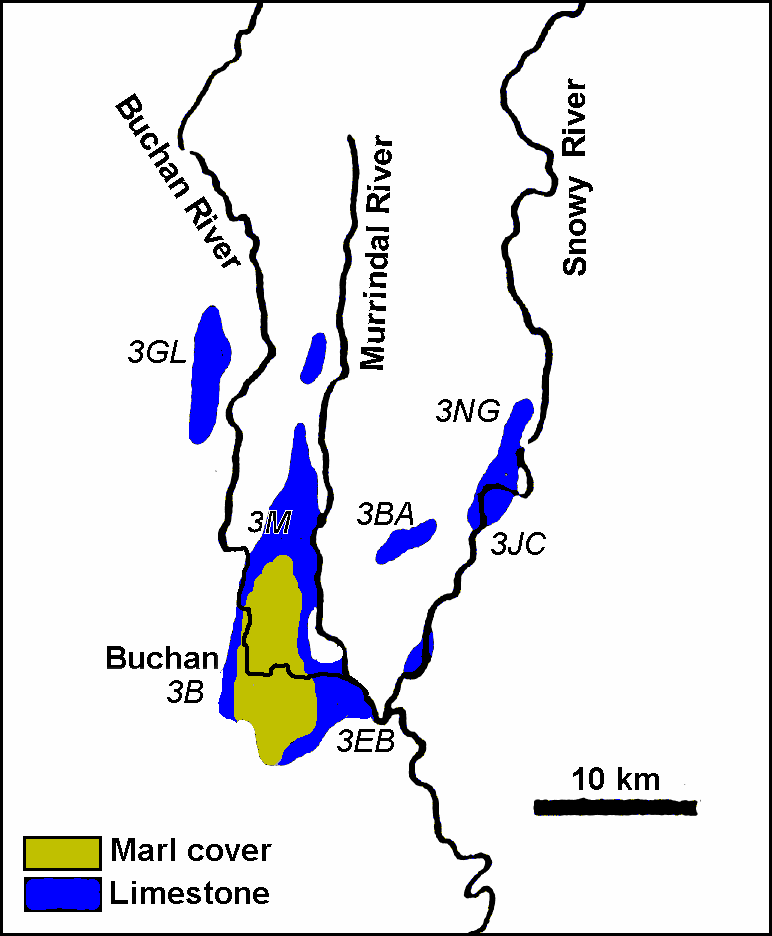
 The Buchan Karst Region (3B, 3M, 3EB), Eastern Victoria, is an impounded karst developed in a synclinal limestone area about 20 km long and up to 10 km wide, but with a a central cover of non-karstic marl. Several smaller impounded karsts lie nearby.
The climate is cool humid (Cfb in the Koppen system) with a rainfall of 817 mm at Buchan town, but increasing to 1300 mm in the ranges to the north.
The Buchan Karst Region (3B, 3M, 3EB), Eastern Victoria, is an impounded karst developed in a synclinal limestone area about 20 km long and up to 10 km wide, but with a a central cover of non-karstic marl. Several smaller impounded karsts lie nearby.
The climate is cool humid (Cfb in the Koppen system) with a rainfall of 817 mm at Buchan town, but increasing to 1300 mm in the ranges to the north.
The first are vertical shafts and fissures such as those of the Potholes area. These are joint-controlled 3-dimensional systems that can locally form complex mazes. They are phreatic systems that have been partly modified by vertical vadose flow after the lowering of the water table during the incision of the Buchan and Murrindal Rivers (see Potholes Interpretation sign).
The second type are horizontal “stream” caves, such as the Dukes cave system at the Reserve (see Federal Cave Interpretation sign). These originated as epiphreatic joint enlargements but have been extensively modified by vadose streams. At present, they are generally dry or have a very small flow but they flood extensively on occassions (Finlayson & Ellaway, 1987).
Both types show evidence of progressive deepening as water tables dropped, and both have cave sediments which provide age and paleoenvironmental evidence (Webb & others 1991). Many caves have been further modified by collapse so that the original form is difficult to deduce.
At the Reserve, the allogenic Spring Creek sinks as soon as it reaches the limestone. Fairy Creek is autogenic and follows the strike of the limestone and is dry for most of the time – its headwaters are near the Buchan Tip. Two main springs are perennial; from Dukes & Moons. Water tracing (Ellaway, 1991, thesis) has shown that water from pools in B-67, not far from the tip, appears in the Dukes Spring 3 weeks later. Flow within the known cave system is confined to flood periods. That, and the relatively constant spring flows, indicate input from diffuse sources as well as cave conduits.
Elsewhere, the Dalleys Cave System (M-35 etc) at The Pyramids is an underground meander cutoff: it diverts water from the Murrindal River, bypassing a surface meander loop and returns it to the river at a lower level (Fabel, & others, 1996). In the Potholes area some underground streams still occur (e.g. Scrubby Creek cave, M-49). The stream leaving Scrubby Creek cave is saturated and deposits tufa in its bed.
Wilsons Cave (EB-4, see interpretation sign below) is a simple intermittent throughflow system at the end of a dry valley.
Webb & others (1991, 1992) have documented the development of the karst in time, starting with uplift of the area and followed by progressive downcutting of the valleys over the last 40 million years (See diagram, and interpretation sign below).
A: The oldest caves, at the Potholes, formed at watertables, well above present levels, that lay beneath a plateau surface 40 million years ago (the number comes from isotope dating of basalt lavas that flowed down the shallow valleys at that time).
B: As the surface cut down, the water tables dropped and the early caves were drained. Many of them cut down into their floors to make vadose shafts and canyons. Pauses in the downcutting allowed intermediate cave levels to form in places. Eventually, surface denudation opened entrances into the higher levels.
C: The final stages, over the last million years or so, involved several knick points (waterfalls and rapids) and alluvial terraces forming in the river valleys, with corresponding horizontal cave levels in the nearby limestone (e.g. The Dukes system at the Reserve and the Dalleys meander cutoff at The Pyramids). The lowest of these cave levels have sediments with paleomagnetic evidence indicating an age of about 800,000 years, so the higher levels are even older (Webb & others, 1992).

|
Part of an Interpretation Sign placed at The Potholes by the Friends of Buchan caves. Describing the evolution of that area and its caves. Click on the image to see a larger version. Potholes.PNG |

|
Part of an Interpretation Sign placed at Wilson's Cave by the Friends of Buchan caves. Describing the evolution of the cave and blind valley. Click on the image to see a larger version. Wilsons.PNG |