
Jenolan would count as "Stripe Karst" as it has a L/W ratio of about 25.
impound-1.png
Many of the Palaeozoic limestones of eastern Australia occur as long but narrow and steeply dipping outcrops (Jennings, 1967, 1976; etc - see readings list below). Many of these would qualify for the extreme case of "stripe karst", defined by Lauritzen (2001) as having a Length/Width ratio greater than 3, with its ideal development at L/W > 30. Stripe karst is distinguished by the overlap of the two contact zones from each side of the limestone belt so that allogenic waters completely dominate the hydrology.
|
|
Maps of three typical impounded karsts. Each is a narrow belt of steeply dipping limestone. Jenolan would count as "Stripe Karst" as it has a L/W ratio of about 25. impound-1.png |
Generally speaking, water flow in these impounded karsts is dominantly through conduits with some bedding or joint influence. Active vadose passages tend to modify earlier phreatic systems. Storage is limited by the small size of the area, so springs tend to be flashy - although less so than non-karstic streams. The underground plumbing is variable and of limited extent in the smallest areas, but can be quite complex in the larger areas, e.g. Mole Creek, Jenolan, Wombeyan.
Outflow is from springs at the lowest point in the surrounding topography - the groundwater is essentially dammed within the limestone by the surrounding impermeable rocks.

|
Structure, allogenic inputs and internal drainage in a typical impounded karst. impound-2.png |
There are exceptions to this general scenario, especially where shallow dips produce more extensive areas of limestone, as at Mole Creek, Tasmania, where more than 200 caves occur in a limestone area about 20 kilometres long by 10 kilometres wide (Jennings, 1967; Kiernan, 1990). There we find a more typical (and complex) karst drainage.
|
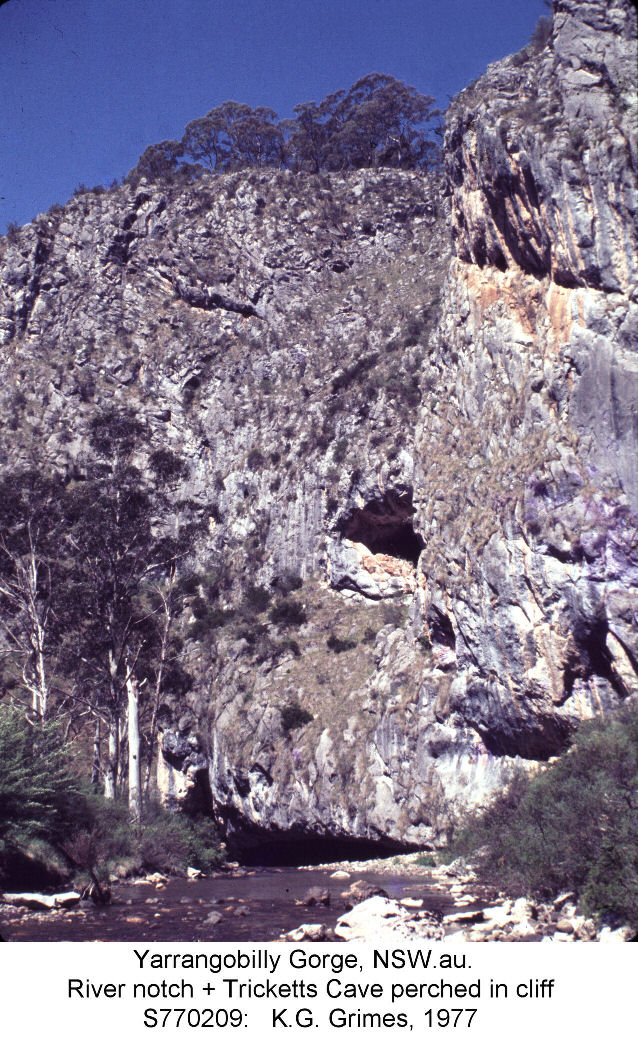
Yarrangobilly Gorge, with the entrance to an abandoned stream cave perched high in the cliff. S770209.jpg |
Because the limestones of the tropical impounded karsts stand above the surrounding rocks allogenic drainage is much less important and stream caves are rare. On the other hand vertical rainwater inflow shafts are common.
|
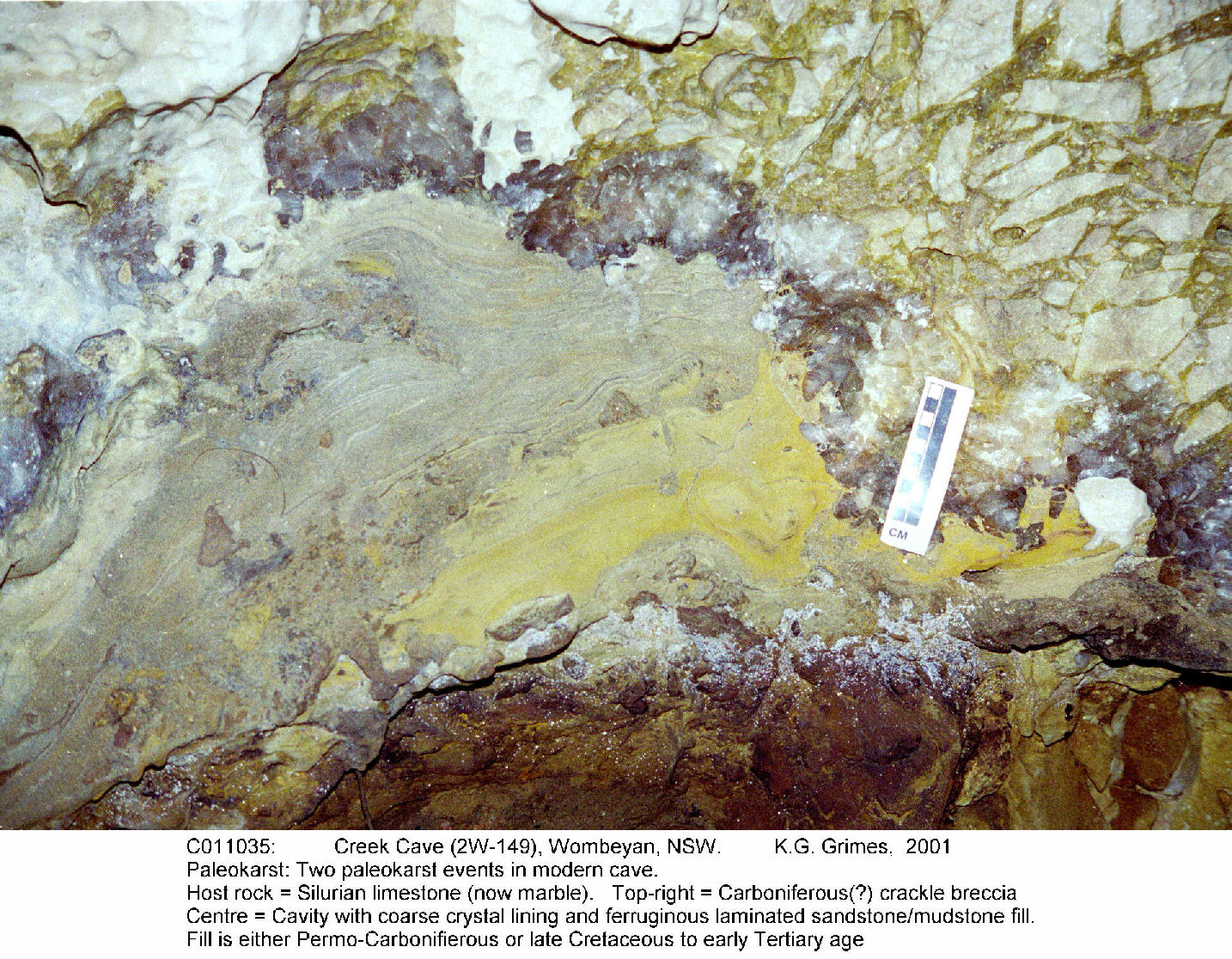
Multi-generation paleokarst at Wombeyan. 1: The host rock is a Silurian marble. 2: The oldest paleokarst, at top right, is a crackle breccia of possible Carboniferous age. 3: That has been cut by a later cavity with coarse sparry lining and a laminated sediment fill of uncertain age - possibly Permo-carboniferous, late Cretaceous or early Tertiary (Osborne, 1993). 4: The present cave cuts all. Creek Cave, Wombeyan, NSW. 10 cm scale bar C011035.JPG |
|
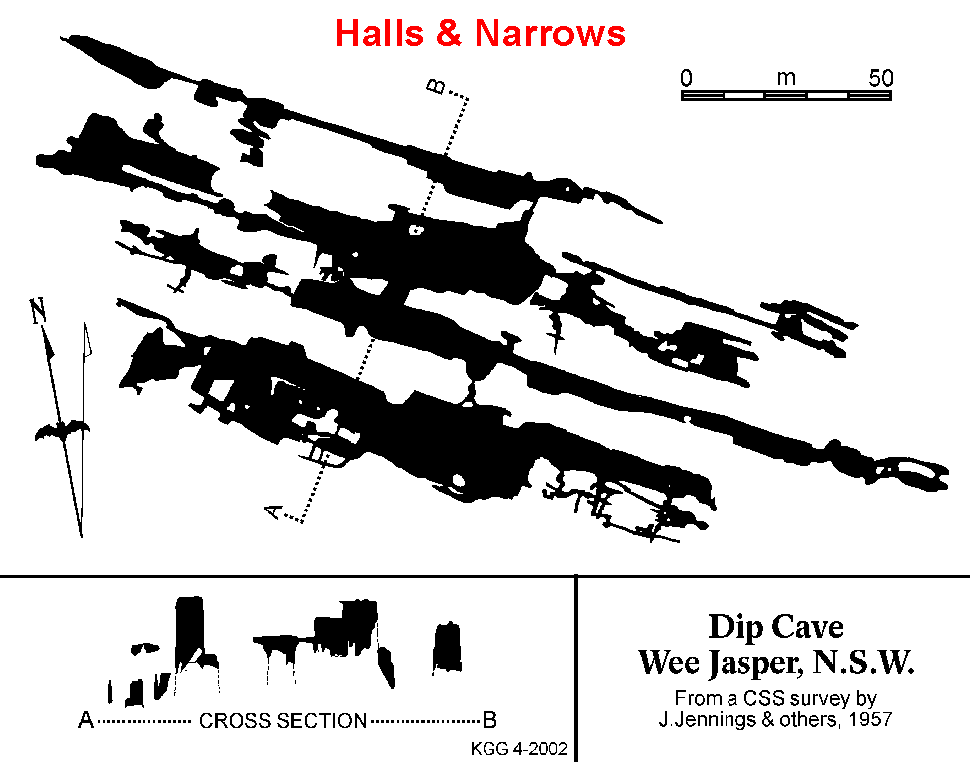
Phreatic systems in steeply dipping limestones can show a "Halls and Narrows" pattern (Osborne, 2001) in which the more soluble beds form large halls with abrupt endings that are joined by small cross-passages (the Narrows) through less-soluble beds. This example is from Wee Jasper, NSW. 2WJ-halls.png |
|
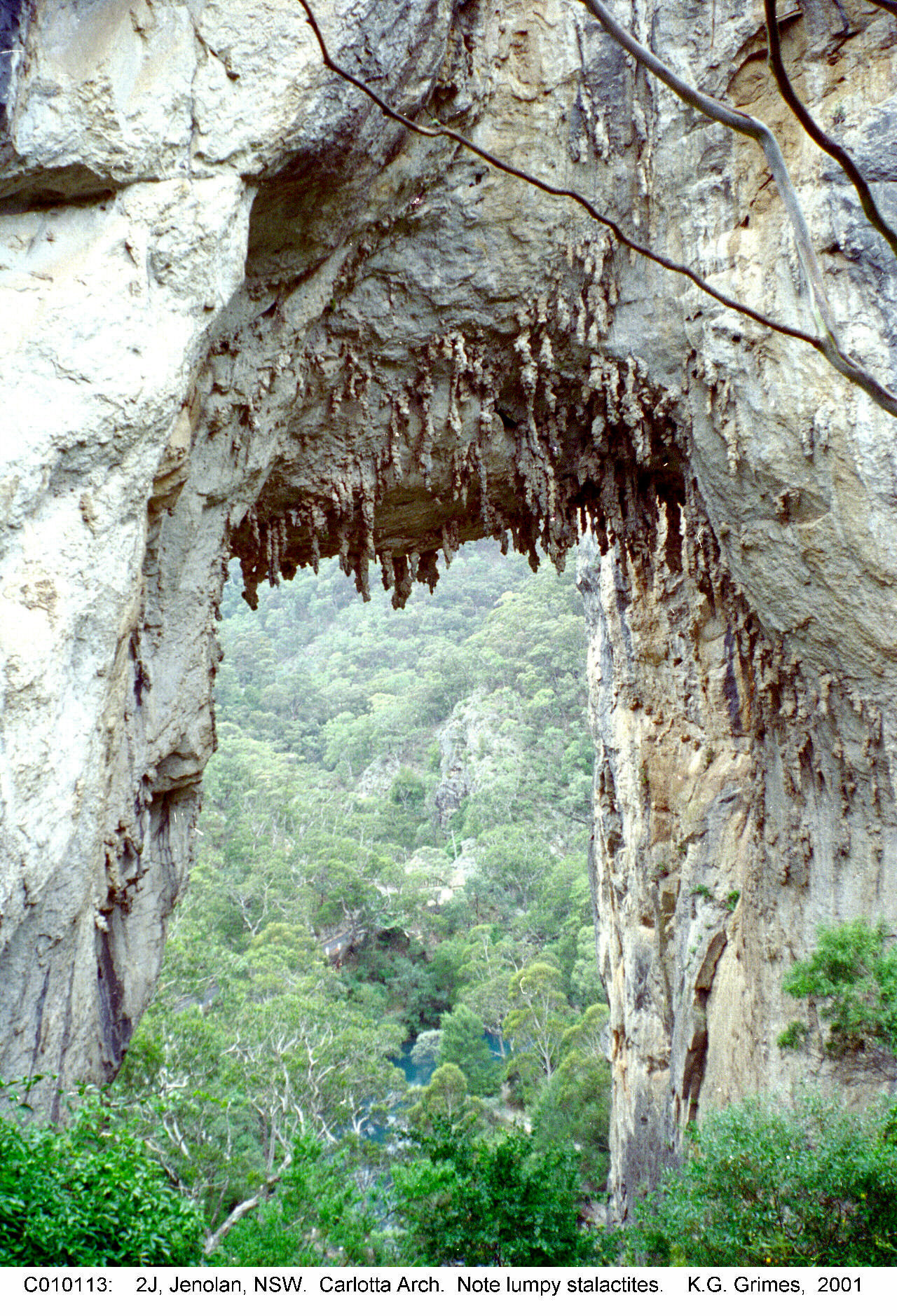
Arches are common where allogenic streams have cut through narrow, steep-dipping beds of limestone. Note the lumpy stalactites, these are organically-influenced "biothems". Carlotta Arch, Jenolan, NSW C010113.JPG |
|
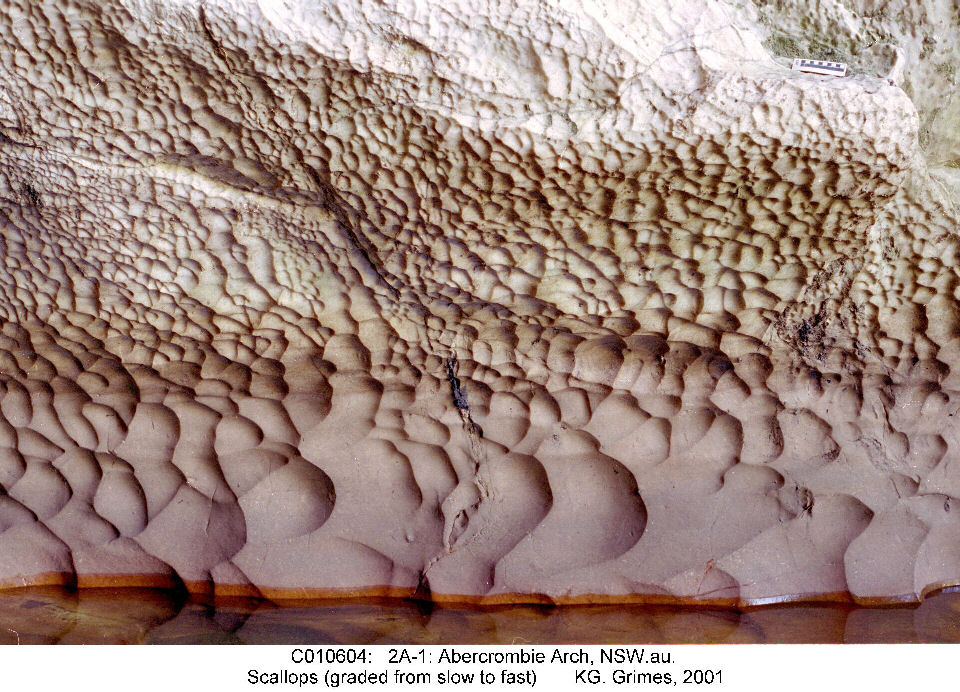
Scallops from stream flows are common. This example from Abercrombie Arch, NSW, shows large (slow) baseflow scallops at the bottom, with smaller, fast-flow patterns formed higher up by flood waters. 10 cm scale bar at top right C010604.jpg |
|
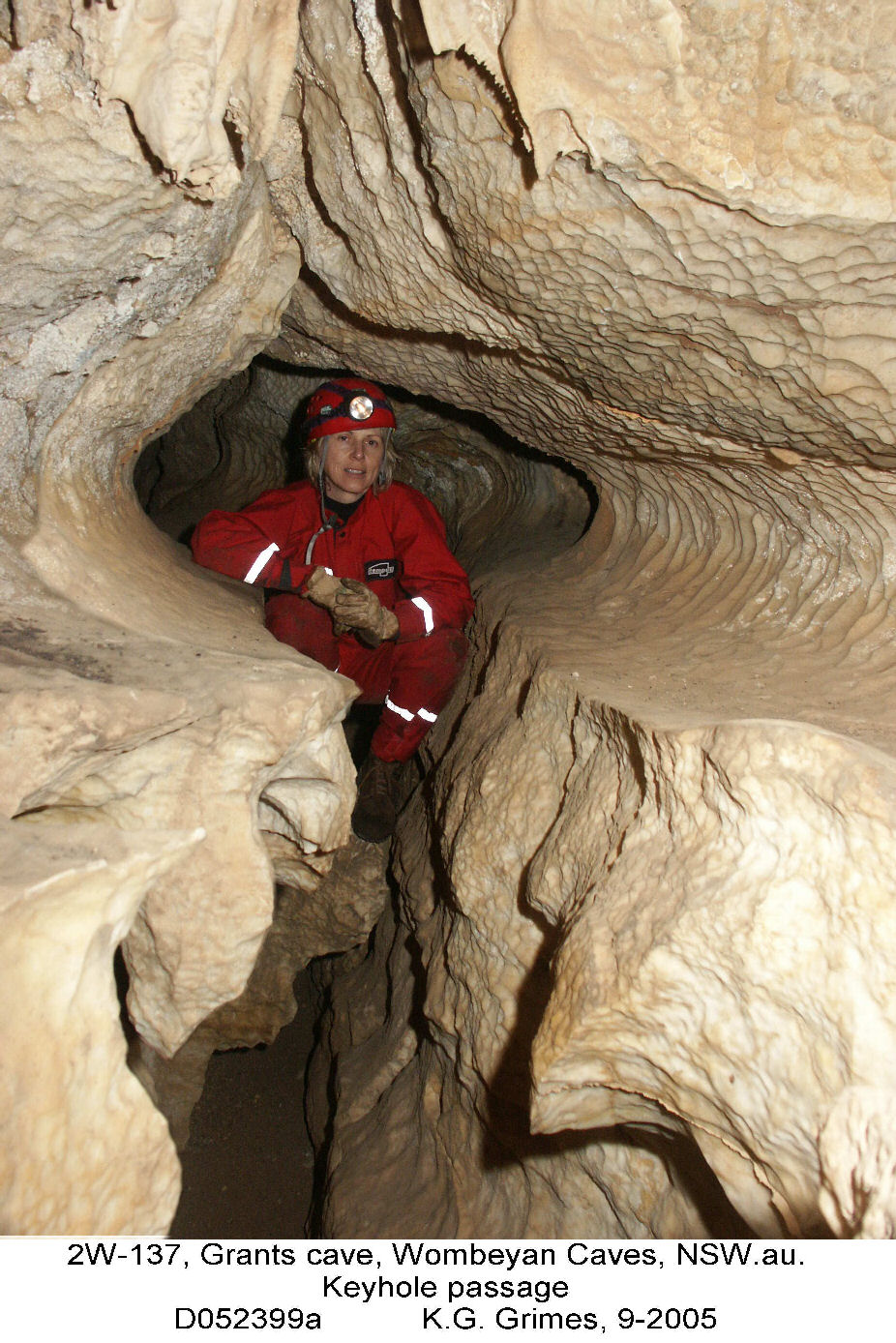
A typical keyhole passage, with scallops, formed by stream incision. Grants Cave, Wombeyan NSW. D052399a.JPG |
|
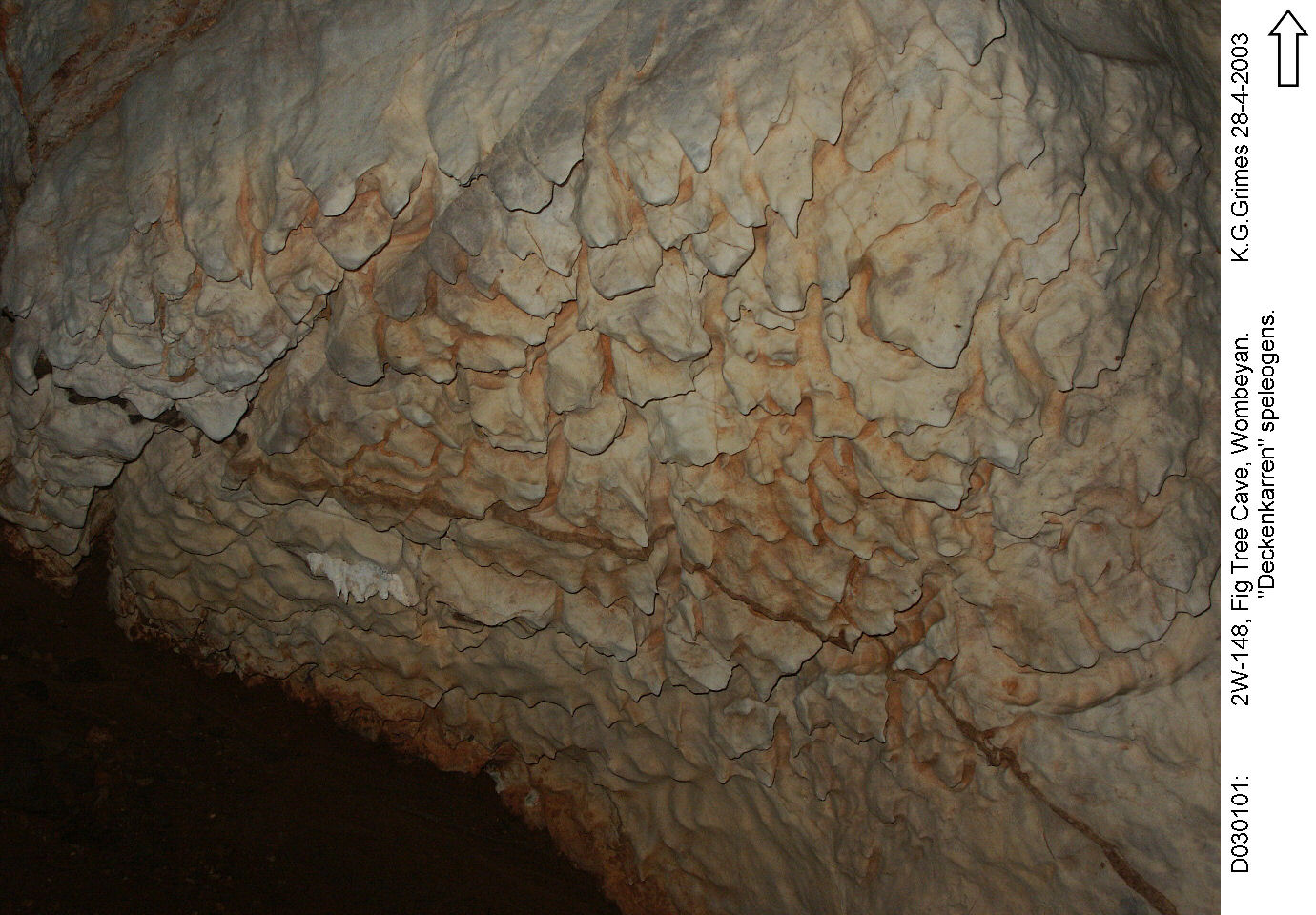
paragenetic sculpturing patterns formed in a sediment-filled cavity where water was moving along the sediment-limestone contact and dissolving channels into the limestone. Later removal of the sediments exposed the structures. FigTree Cave, Wombeyan, NSW. D030101.jpg |
|
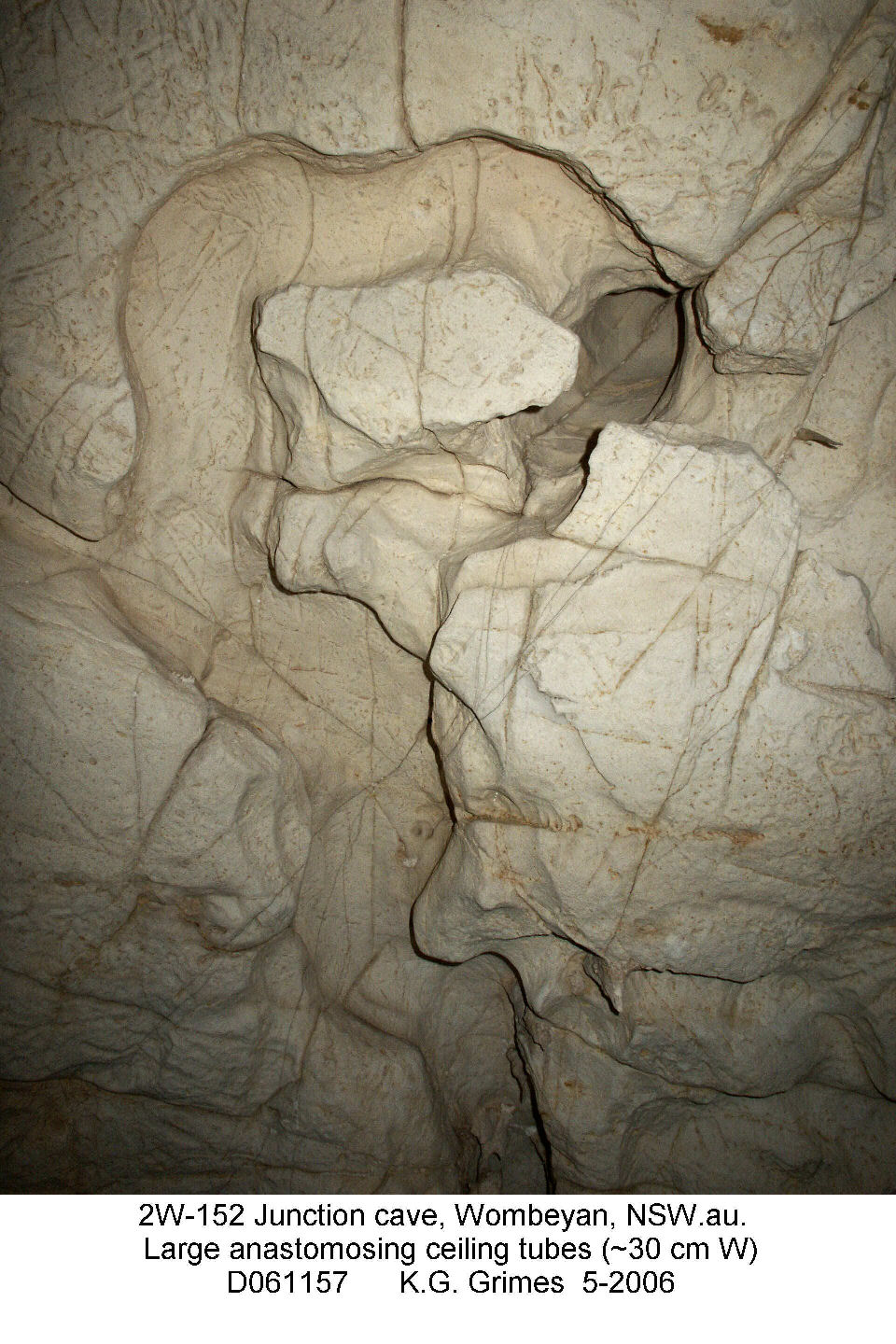
This roof channel (about 30 cm wide) may also have formed paragenetically, when water was forced up against the ceiling, or it may be an early phreatic tube following an inception horizon. Junction Cave, Wombeyan, NSW. D061157.JPG |
|
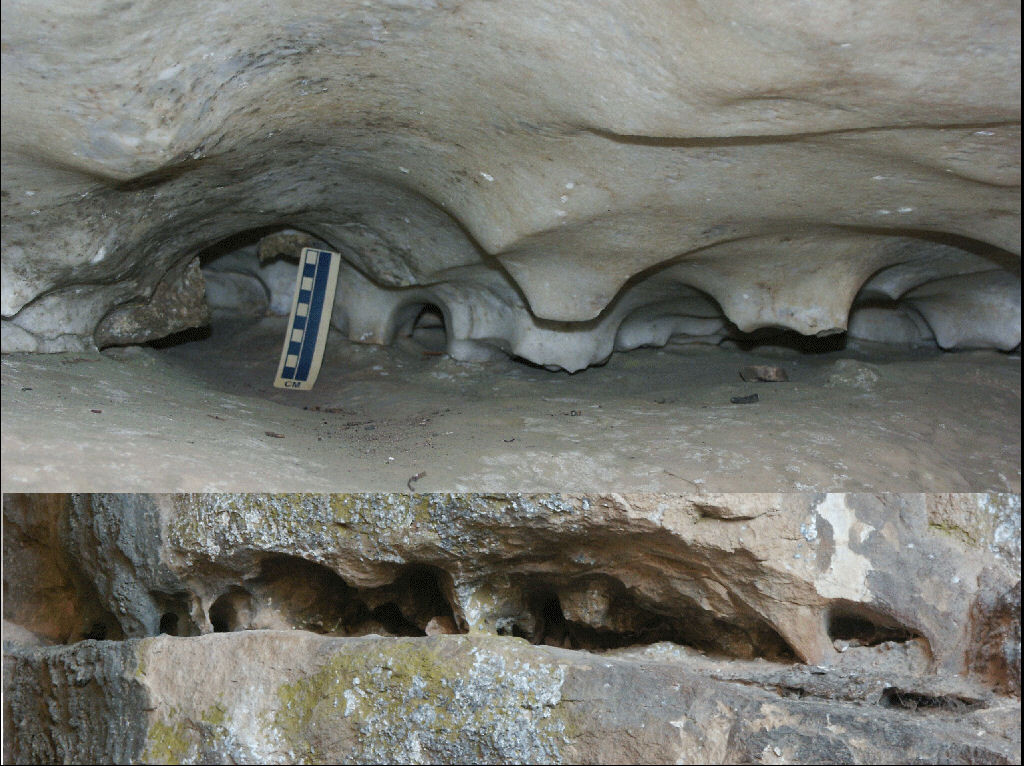
Side views of two slots with what appear to be anastomosing half-tubes. Are these left from the early phreatic preparation of the system? Or are they the result of modern aggressive allogenic flood waters being forced into cracks beside a stream passage? Victoria Arch, Wombeyan, NSW. sld091.jpg |
|
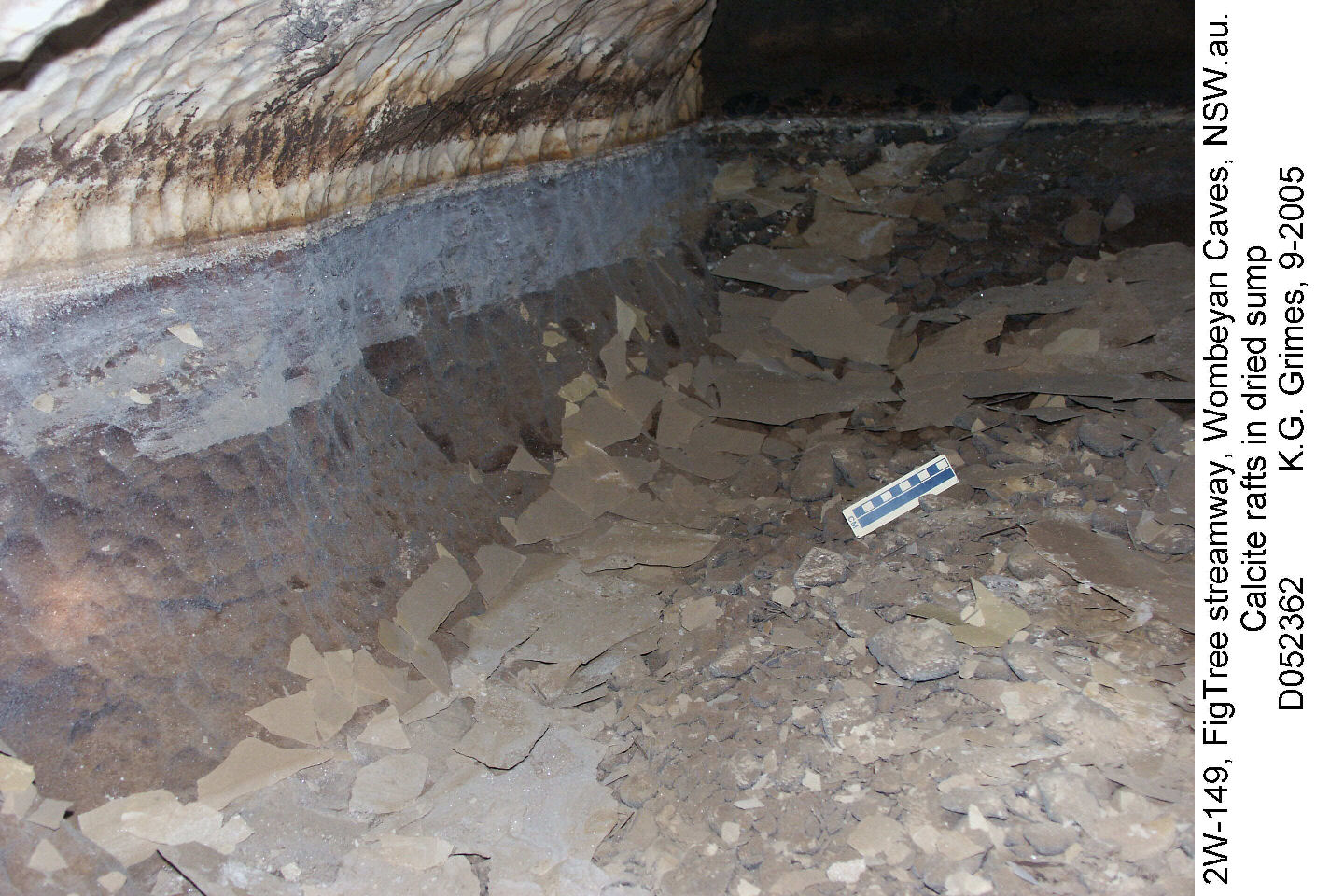
Calcite rafts left after the drying of a cave pool during extreme drought (2005) FigTree streamway, Wombeyan Caves, NSW. 10 cm scale-bar D052362.JPG |