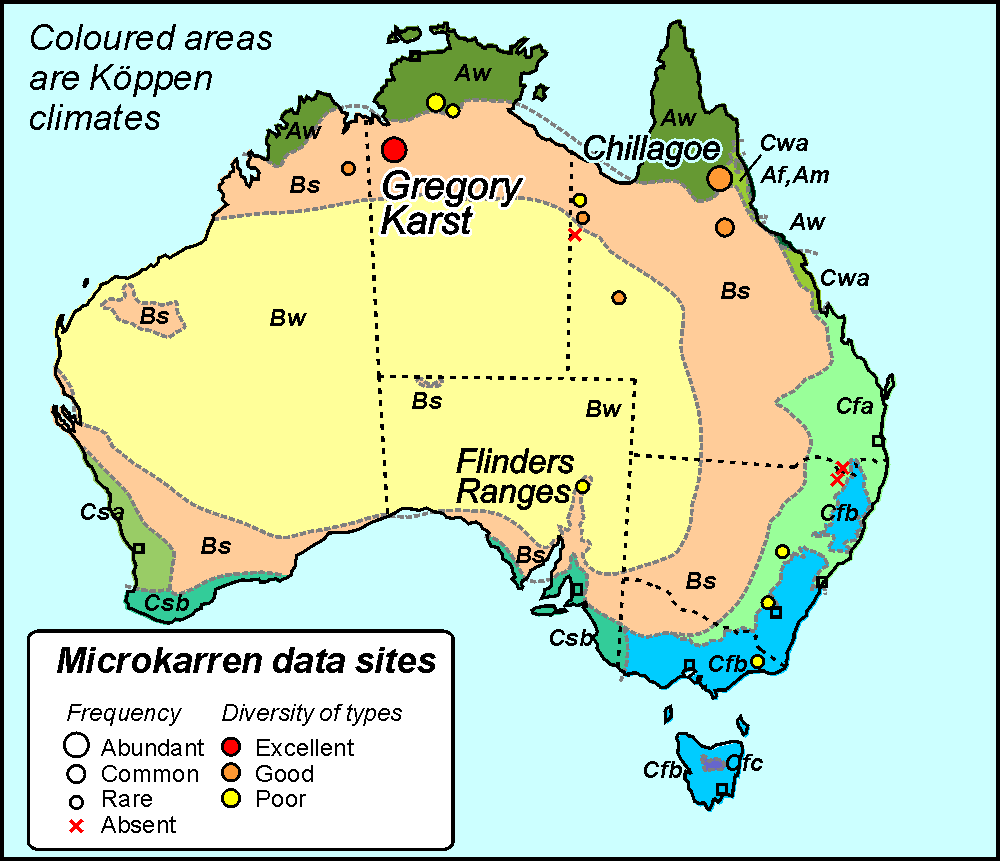
Brief descriptions follow of Australian sites that have microkarren, or which have been searched and found barren (or nearly so). The negative data is as important as the finds!
Note that some "microkarren" features, such as etching of fossils and rock structures and many pitting effects (subsoil?), seem ubiquitous and unrelated to the more distinctive "true" microkarren types such as micro-rills. The presence of etching or pitting on their own was not taken as an indication that "true" microkarren were present.
It is still too early to comment on controlling factors. However, the best developed sites so far are in areas that are semi-arid, or at least seasonally dry (see climate zones on map below). In some places there seemed to be a local preference for beds of finer-grained limestones (lutites), but note the (admittedly poorer quality) microkarren on the marble at Chillage which has crystals up to coarse sand size.
|
|
Sites which have been searched for microkarren in Australia. |
The first outcrop visited, on the walking track in to Mini Palm Gorge, had lots of etching of cracks etc, but only poor examples of microkarren. Another outcrop beside the Gorge Road further southwest was of thin-bedded limestone and had well developed microkarren (straight & branching micro-rills up to 7cm long, toothy-rills, micro-teeth & -pits and a few micro-networks) which was localised to specific beds. Some micro-pits were quite deep and conical. Photos KG082797-808.
The best development of microkarren is on the flaggy to slabby outcrops of fine-grained dolomitic limestone in the Proterozoic upper Skull Creek Formation, where there is little competition from mesokarren. Nearly all outcrops in this unit have examples of microkarren.
However, microkarren do also occur within the main karrenfield of the Supplejack member. They are common in zone 1, which has only recently been exposed by erosion of the cover sediments, but also occur in the more dissected zones, usually at the tops of spitzkarren and associated with rillenkarren and rainpits on gentle slopes.
All types are present and well-developed, including the relatively rare micro-pans and -tessellations. Most of the photos in the poster come from this area.
The micro-rills, -networks, -teeth and -pits are forms that grade into each other. It is common to find on undulating surfaces that the crests have micro-pits or micro-nets that grade to linear, sinuous or tightly meandering microrills on the slopes. In the hollows, networks and pits may reappear or there may just be a smooth surface. Cobble surfaces commonly show radiating vari-width, round-crested rills. The micro-pans and micro-tessellations appear to always be late-stage features that are superimposed on other microkarren. Microrills can co-exist with shallow, incipient rillenkarren and "rain-pits" (e.g. photo D051039). There is also common etching of fossils (stromatolites) and structure.
Some observed successions of types are:
There is some local lithological control – on the laminated stromatolite outcrops one can see better development of microrills on the finer-grained paler laminae than on adjoining darker (organic rich?) and coarser laminae (see photos D050997, 1166).
This low hill of Cambrian limestone is on the west side of the highway, 3.3km NW of the bridge over the Katherine River (Grid 020014).
The crystalline limestone lacked microkarren. However, a single bed, 15cm thick, of fine-grained cream-coloured limestone had fairly well-developed microkarren. This bed is on the ridge right beside the road, about 2m up from road level, to the left (SE) of the "Zion" rock (painted graffiti). The microkarren included rounded teeth on the tops of cobbles grading to radiating toothy micro-rills up to10cm long that died out as the surface became steeper. Some cobbles also had round-topped vari-width rills. On larger flags linear rills ran down slopes of 10-20°, and these were up to 15cm long, moderately sinuous and branching. A few patches graded to micro-networks and -teeth or just smooth surfaces. Photos KG082177-85.
An outcrop beside the highway (at Danuta's sinkholes, GR 252894) had one patch of sinuous toothy-rills (photo 1334)
Cambrian limestone outcrops on the hills south of main sandstone gorge. This has poorly developed microkarren: scattered patches of teeth and short toothy-rills and vari-width rills. Photos KG080183-6.
There is good etching of cracks and joints in the Cambrian dolomite (see Etchings) and some fine pitting.
A single specimen was collected in 1972 from Cambrian Chatsworth Limestone. This has good-quality radiating micro-rills and toothy-rills with some vari-width rills on the upper surface and linear decantation rills on the side which became less pronounced downwards. There was fine pitting on the underside, which had been in contact with the soil. See last two photos in 4BK/4BK-Micr.htm
The Devonian limestone includes both unmetamorphosed "sparry" limestone and cystalline marble with grains up to 3mm wide. The best microkarren are on the spar, but reasonable exampels of rills and toothy rills were seen on the marble.
Types include: linear and branching rills, grading via networks to teeth. Some patterns were very shallow and only recognisable from their bleached crests (photo D030777-8). Toothy rills were also common. Pits showed all size gradations from micro-scale (1mm) up to typical rainpits 91-2cm). A few specimens of poorly-developed micro-tessellations may be just etchings of fossil structures? (photo D030752). Etching of fossils and structure was common.
They are mainly linear, low-sinuosity micro-rills (photos KG083985-6, 92-3, 4078, 80-1) with less common micro-teeth, -pits, -networks and toothy-rills (ph 3985-6, 4079, 86-7, 88, 89) and a few vari-width, round-crested radiating rills. These are found most commonly in the bleached areas (Wallaby scats/urine) which supports Joe Jennings' (1981, 1982) suggestion of a relationship much better than was seen at Chillagoe or the Gregory Karst where there is not such a strong correlation with bleaching. Photos 4143, 49 show a line of bleached limestone along a wallaby trail. Photo 4127 shows abundant scats & microkarren at a wallaby kipping-spot.
No microkarren found. But there is strong etching of grains & fossil structures. However the site was a quarry with only limited undisturbed outcrop
1: An isolated flat pebble has well-developed micro-teeth on one (upper?) side and rounded teeth on the underside. The teeth wrapped around the edges as short coarse rills (see photo on last page of the Poster).
2: Along a thin (0.5m) outcrop of steep-dipping rich-Y-brown-coloured (fine-grained?) dolomite (Late Adelaidean Wonoka Fmtn) there were many etched v-notches (splitkarren) in a range of sizes from 1 to 5 mm forming grid patterns following joints (and possibly bedding in some cases). These disrupt patches of short micro-rills & -teeth. Also some longer rills (locally becoming toothy) and several thin beds with decantation rills. One thick bed has smooth-floored rillenkarren with some widths down to 0.5cm. Some pitting.
There were only a few vague, coarse rills (~3mm wide, photos D071710, 11, 20). Common etching of structures & cracks.
One small cobble had poor micro-teeth (photo D071762). There is some etching of structures & pitting.
There were rare, ill-defined (on etched fossils) micro-rills that tend to break up into toothy rills and areas of small teeth. There were also areas of pits in various sizes, some apparently etched rock fragments, and the usual etching of fossil and rock structures.
East Buchan (3EB, Wilsons Cave): None found
Murrindal (3M, Potholes): Very rare and poor quality.
Rare deep pits 1-10mm wide. One patch of very-poor-quality, short toothy rills. Common etching of fossils and grains.
Buchan Reserve (3B): Rare, fair quality.
Rare micro-teeth and toothy rills, some poor-quality rills (up to 10cm long). Very rare decantation rills (2-5cm long) on a steep cobble side. Common etching of sand-sized grains, fossils, cracks & stylolites.
(c) KG. Grimes, 2009