Laterite Karst (and other features of Deep Weathering Profiles)
This set of pages covers karst-like features associated with tropical Deep Weathering Profiles (DWPs), including "Laterite Karst" (or more precisely, "laterite parakarst").
Deep weathering involves the intensive chemical weathering of the minerals in a rock over a long period of time. A variety of chemical reactions are involved: solution, hydration, oxidation, etc. The minerals are converted to new forms which may be soluble, and can be removed in solution (analogous to karst); or may be softer, such as clay minerals, or crumbly, such as residual sand grains, and can be washed out of the rock by flowing water, a process called piping.
Strictly speaking the solutional process and resulting features are classed as "silicate karst" (or parakarst) and the mechanical erosion via the piping process is classed as a form of pseudokarst. But both processes tend to occur together and the general term "laterite karst" is therefore useful. Laterite karst shows a stronger analogy with the syngenetic karsts than with the classical "hardrock" karsts – both laterites and syngenetic karsts have simultaneous solution and cementation and show the influence of caprocks (aka duricrusts) on cave development.
The resulting landforms vary from broad-scale, shallow dolines, or "pans" (up to 2km across) through a variety of meso-scale features such as solution pipes and pinnacles to smaller-scale vughs and breccias. As well as solution and removal of material, hard indurated bands, called "duricrusts" form in the upper part of the weathering profile. These are named according to the composition of the hard cementing material: ferricrete (Fe), silcrete (Si), calcrete (Ca), bauxite (Al). Laterite is another name for ferricrete, but the term is also used in a broad sense for the whole weathering profile.
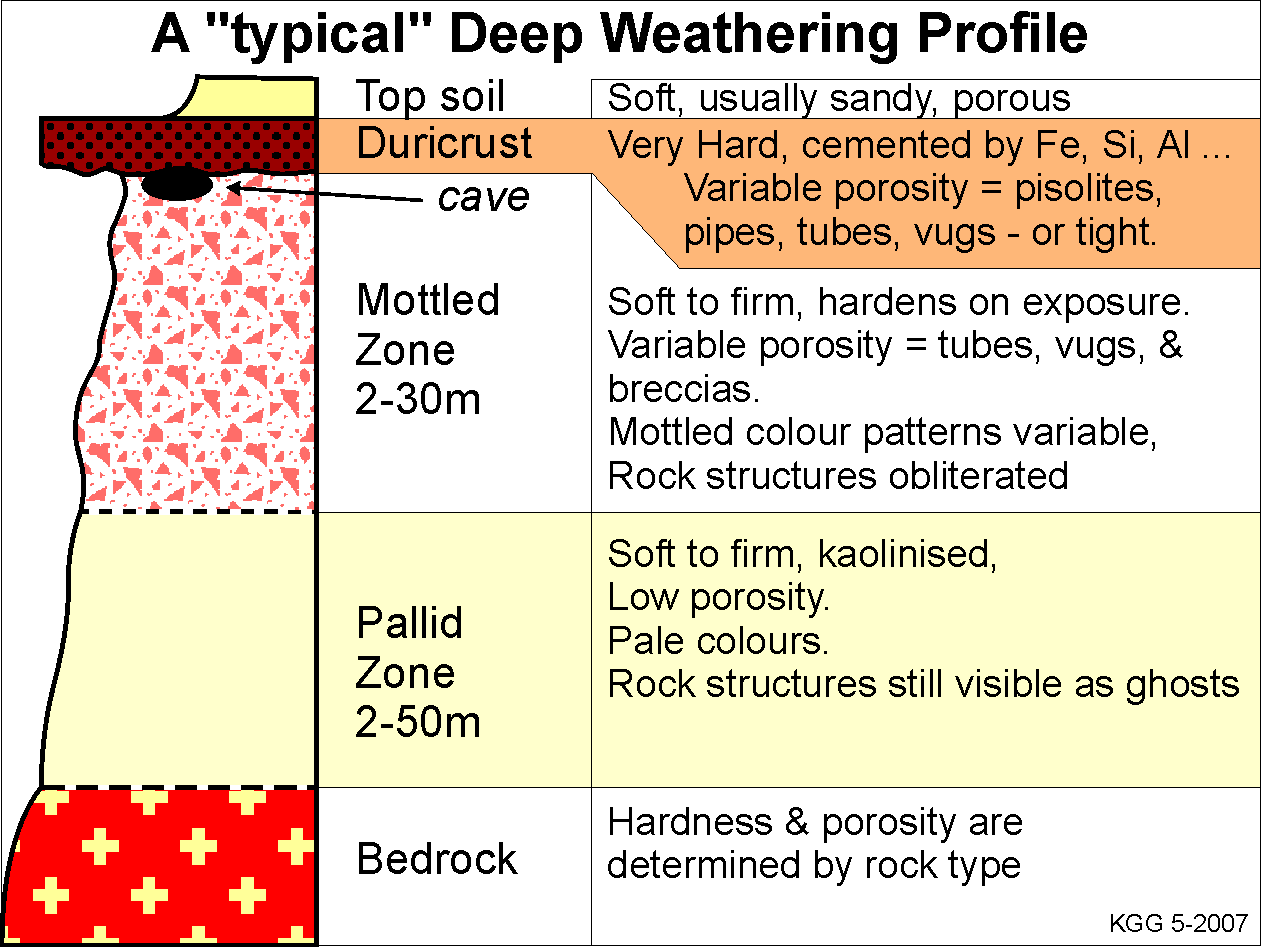
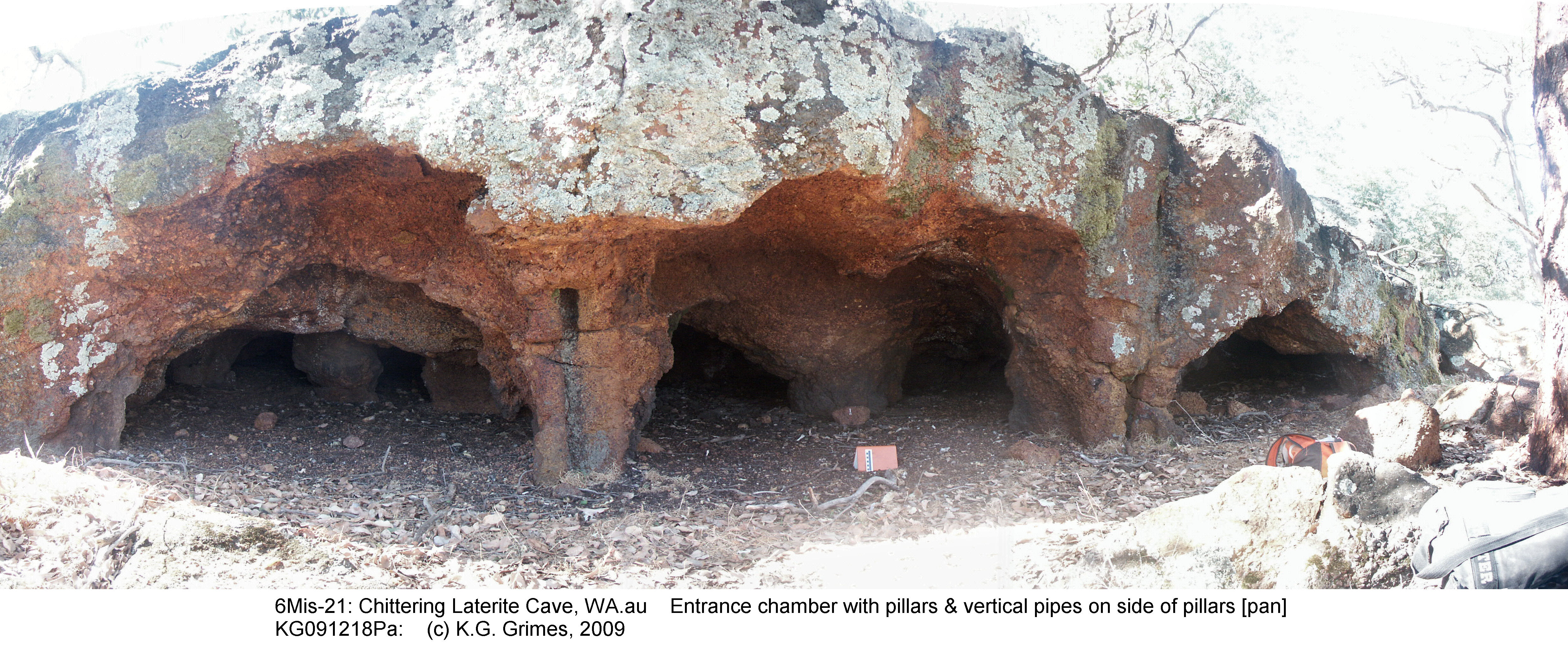
Caves typically occur in the softer weathered material beneath the duricrusts, which provide a hard roof. Solution and piping removes the softer material to form small caves, some of which can be complex mazes (e.g.
Lefroy & Lake, 1972)
The diagram shows a "typical" DWP. But there is a lot of variation between and within profiles. Secondary (karstic) porosity is most common in the mottled zone and within the duricrust, but again there is much variation - some duricrusts are quite impermeable and perched watertables occur above them.
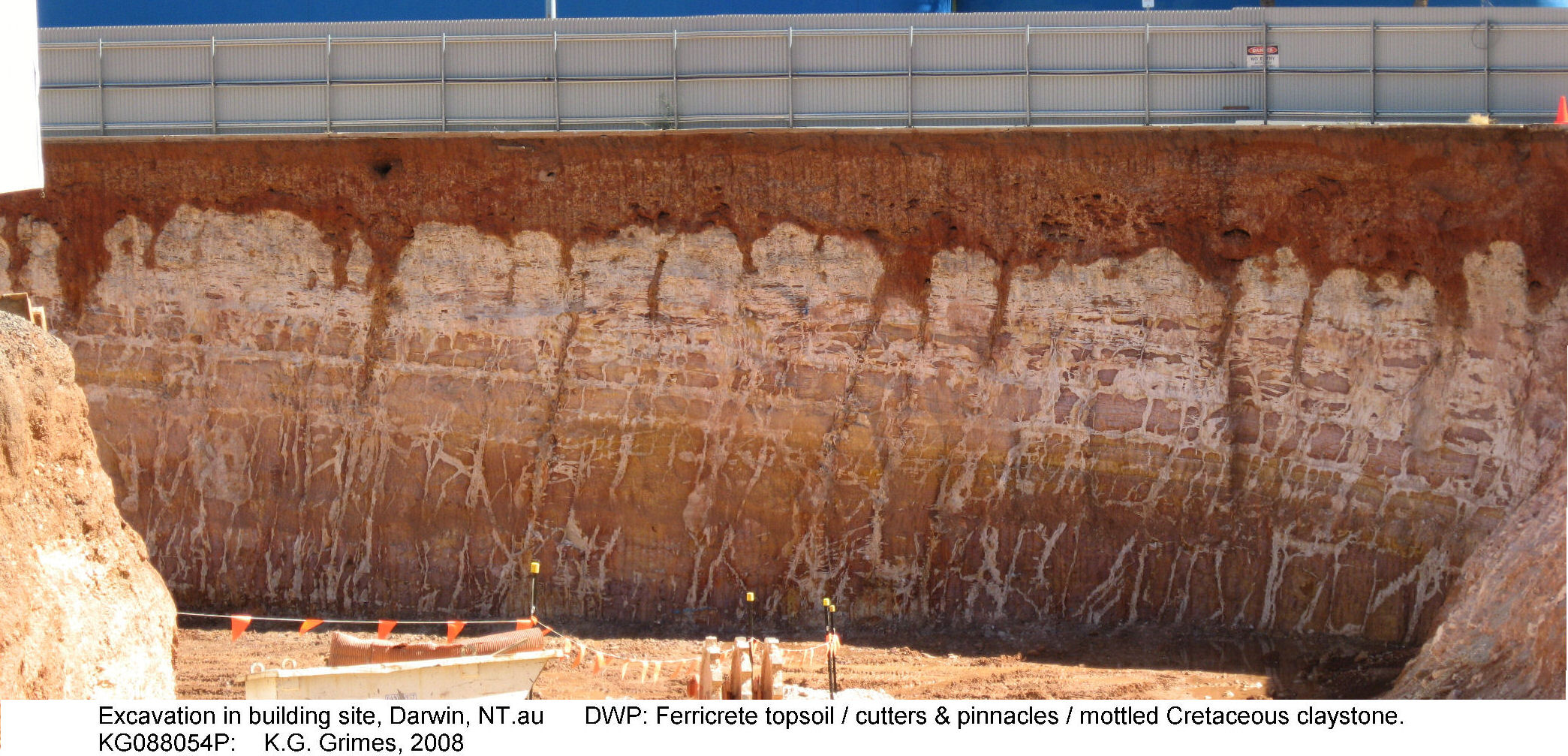
This exposure is atypical for a DWP, but of interest as it shows karstic features.
It has a (younger?) ferruginous soil overlying an "epikarst" surface of cutters and pinnacles above a mottled zone developed on a gently dipping Cretaceous claystone. The mottles are elongated along joints or small solution tubelets.
A construction pit in Darwin, NT.
|
Laterite duricrust forms a cap above a shallow maze cave with pillars and pendants. Chittering, WA.
Notebook is 12x18 cm.
KG091218Pa.JPG |
Further reading
Photos of silicate karst features associated with Deep Weathering Profiles (mainly laterite and silcrete)
Go to Main Index menu